Last updated: September 2026. Visa rules may change. Verify at ica.gov.pg before applying.
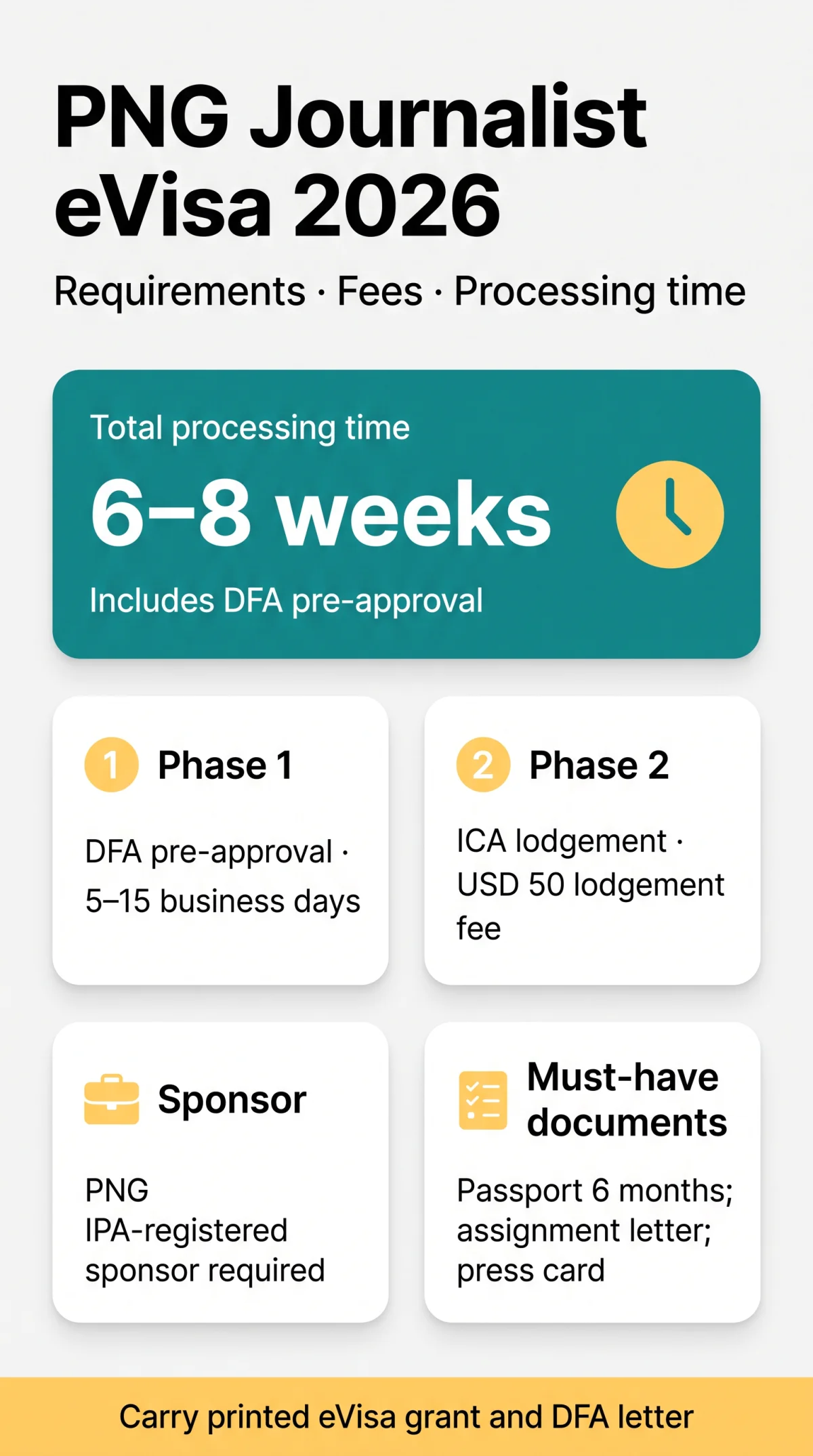
UK journalists must secure PNG Department of Foreign Affairs (DFA) pre-approval before lodging a Journalist eVisa application through the ICA portal. Understanding png evisa journalist visa requirements begins with this two-phase process: a PNG-based IPA-registered sponsor, a USD 50 lodgement fee plus applicable Migration Service Fee, and 6 to 8 weeks lead time. The PNG Journalist eVisa falls under the Work visa class and is mandatory for all paid and unpaid media activity in Papua New Guinea.
Who Needs a PNG Journalist eVisa?
The PNG Journalist eVisa (Work class) is mandatory for all journalists, photojournalists, and broadcast correspondents conducting paid or unpaid media reporting in Papua New Guinea. Documentary researchers and freelance media professionals also need this visa. Per the ICA Work Permit Handbook (2022 edition), the journalist eVisa covers news reporting, editorial photography, press interviews, and media research trips. Non-qualifying activities include commercial documentary production, entertainment filming, and advertising content creation. Journalist visas receive additional scrutiny from PNG authorities.
| Attribute | Journalist Visa | Tourist Visa | Entertainer Visa |
|---|---|---|---|
| Visa class | Work – Journalist | Visitor | Work – Entertainer/Specialist |
| Permitted activities | News reporting, press coverage, editorial photography | Tourism, leisure travel | Commercial documentary, entertainment filming |
| Key requirement | DFA pre-approval + assignment letter + press credentials | Standard passport + return ticket | Specialist sponsorship + production permit |
News reporting requires a Journalist Visa; a streaming-platform documentary may require an Entertainer or Specialist Visa; commercial advertisements require a Restricted Employment Visa. Incorrect classification may result in visa denial or removal. When reviewing png evisa journalist visa requirements, ICA classifies based on the primary purpose of visit.
Required Documents & Sponsor Requirements
Applicants must upload the following to obtain the PNG Journalist eVisa. The PNG media visa requires all items below for ICA acceptance.
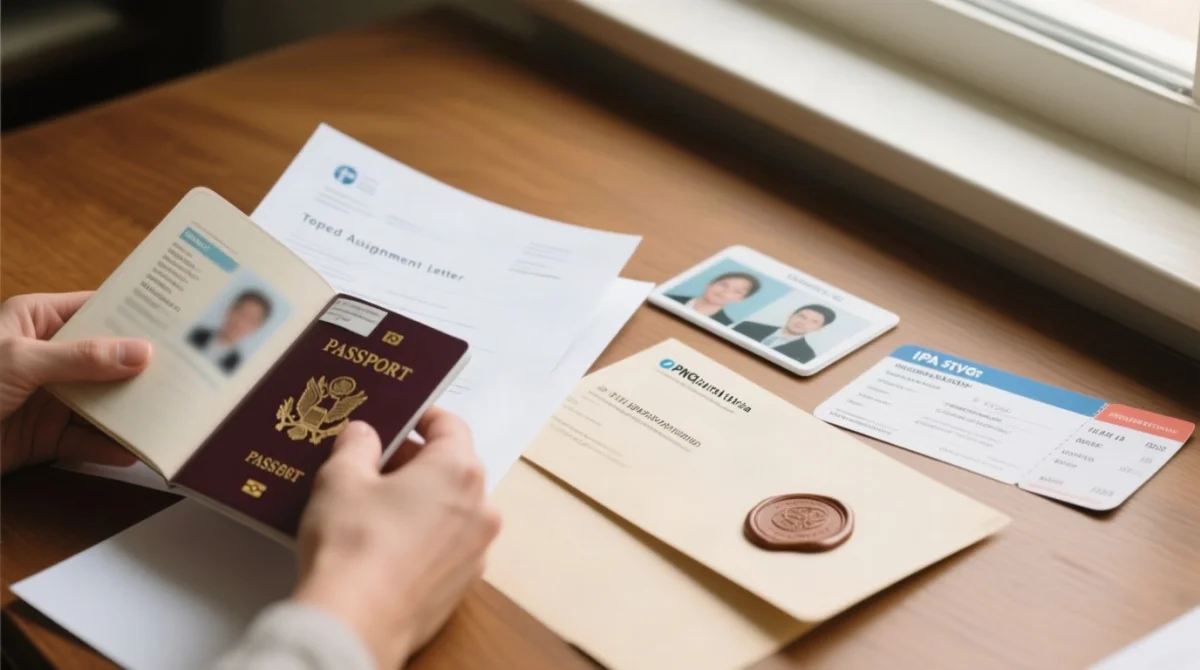
- Valid passport with minimum 6 months’ validity from intended date of entry
- Scanned colour copy of passport bio page
- Recent digital passport-style photograph (white background)
- Letter of assignment on company letterhead including journalist’s name, purpose, travel dates, PNG locations, and employment confirmation
- Sponsor invitation from a PNG entity registered with the Investment Promotion Authority (IPA), on letterhead with seal and authorised signature, specifying planned activities, duration, locations, and financial maintenance guarantee
- Press credentials or media card (e.g., NUJ card for UK journalists)
- Return or onward flight itinerary
- Proof of accommodation in PNG (hotel booking or host organisation address)
- Supporting statement describing editorial purpose and scope of visit
The sponsor must be located in Papua New Guinea and IPA-registered; the invitation letter must state financial maintenance confirmation. Submit all items through evisa.ica.gov.pg. These png evisa journalist visa requirements cannot be waived.
How to Apply & What It Costs
The journalist eVisa for Papua New Guinea requires a two-phase process: DFA pre-approval first, then ICA online lodgement at evisa.ica.gov.pg using the clearance reference number.
Phase 1 – DFA Pre-Approval
Prepare a press synopsis, editorial cover letter, media credentials, list of PNG locations, and expected arrival/departure dates. Submit to the DFA media liaison unit. Await response for 5 to 15 business days. The pre-approval letter contains a clearance reference number required for the next phase.
Phase 2 – ICA Online Lodgement
Create an account on evisa.ica.gov.pg, select “Work Visa: Journalist,” and enter the DFA reference number. Upload all required documents, then pay via the MICA portal at ica.gov.pg/register. Submit and save the tracking number.
The PNG journalist visa costs a USD 50 online lodgement fee plus the Migration Service Fee per ICA’s published schedule (amount varies by subclass). Fees are in USD, converted to PGK at registration finalisation. Payment is accepted via major credit/debit cards through the MICA portal or in person at the Immigration Finance Office, ground floor, Central Government Office. ICA processing takes 24 hours to 10 business days; allow 6 to 8 weeks total including the DFA stage. A typical application with complete documentation requires 12 business days for DFA clearance and 3 business days for ICA processing.
Validity, Arrival & Equipment Rules for UK Journalists
PNG Journalist Visa validity ranges from 30 to 90 days, determined case-by-case by ICA based on assignment scope and DFA conditions. The PNG eVisa for Journalists and Media Workers permits single or multiple entries per assignment. Extensions require contacting ICA; applicants must report any change of circumstances immediately to avoid eligibility issues and additional fees.
The Digital Arrival Card is mandatory since October 2025; declare journalist status to prevent secondary inspection for undeclared broadcast equipment. UK journalists are not visa-exempt and must apply via evisa.ica.gov.pg. The Australian High Commission in London handles PNG consular services for UK residents (verify at ). Carry printed border documents: eVisa grant notice, DFA pre-approval letter, assignment letter, and NUJ credentials. Freelancers need commission proof.
An ATA Carnet is required for temporary import of professional broadcast cameras, audio rigs, and lighting kits into PNG. PNG Customs may demand a 10 to 20% security deposit bond based on equipment value. Prepare an itemised packing list with serial numbers and estimated values. Commercial drone operations require CASA PNG certification, and wireless transmission equipment (microphones, satellite uplinks) requires NICTA spectrum clearance. Both permits are independent of the journalist eVisa. Primary entry is Jacksons International Airport, Port Moresby.
FAQ: PNG Journalist eVisa Requirements and Application Process
Can I apply for a PNG journalist eVisa without a sponsor in Papua New Guinea?
No. A PNG-based, IPA-registered sponsor must provide an invitation letter on company letterhead with seal and authorised signature. Without this invitation letter, the ICA portal application cannot proceed.
How long does the PNG journalist eVisa take to process?
ICA processing takes 24 hours to 10 business days after submission. DFA pre-approval adds 5 to 15 business days beforehand. Allow 6 to 8 weeks total from initial DFA contact to eVisa grant notice.
What is the total fee for a PNG journalist eVisa?
The online lodgement fee is USD 50, payable via the MICA portal at ica.gov.pg/register. The Migration Service Fee applies per ICA’s published schedule for the journalist and work visa class. Fees are charged in US Dollars and converted to PNG Kina at registration finalisation.
Can I extend my journalist visa while in PNG?
Extensions may be possible by contacting ICA directly while in-country. You must provide updated assignment documentation and report any change of circumstances immediately. Additional Migration Service Fees may apply. Contact ICA at +675 327 6100 for guidance.
What happens if I overstay my PNG journalist visa?
Consequences include daily fines, detention, deportation at your own expense, a potential entry ban from Papua New Guinea, and possible criminal prosecution for serious cases. The validity and stay duration are determined case-by-case by ICA, typically ranging from 30 to 90 days.
Can I enter PNG on a Visa on Arrival as a journalist?
Visa on Arrival is available for limited nationalities but is not recommended for journalist work. Arriving without the correct Work class visa may result in denial of entry or removal. UK passport holders are not visa-exempt and must apply via evisa.ica.gov.pg.
Do I need a separate permit to fly a drone in Papua New Guinea?
Yes. Commercial drone operations require certification from CASA PNG, and wireless transmission equipment requires NICTA spectrum clearance. Both permits are independent of the journalist eVisa and must be obtained separately. Non-compliance may result in equipment seizure, fines, or criminal charges.
Can a multi-person documentary crew apply under a single project dossier?
ICA processes journalist eVisa applications individually. Each crew member, including non-journalist staff such as fixers and sound technicians, should consult ICA regarding their specific visa requirements. A collective project dossier may support but cannot replace individual applications.