
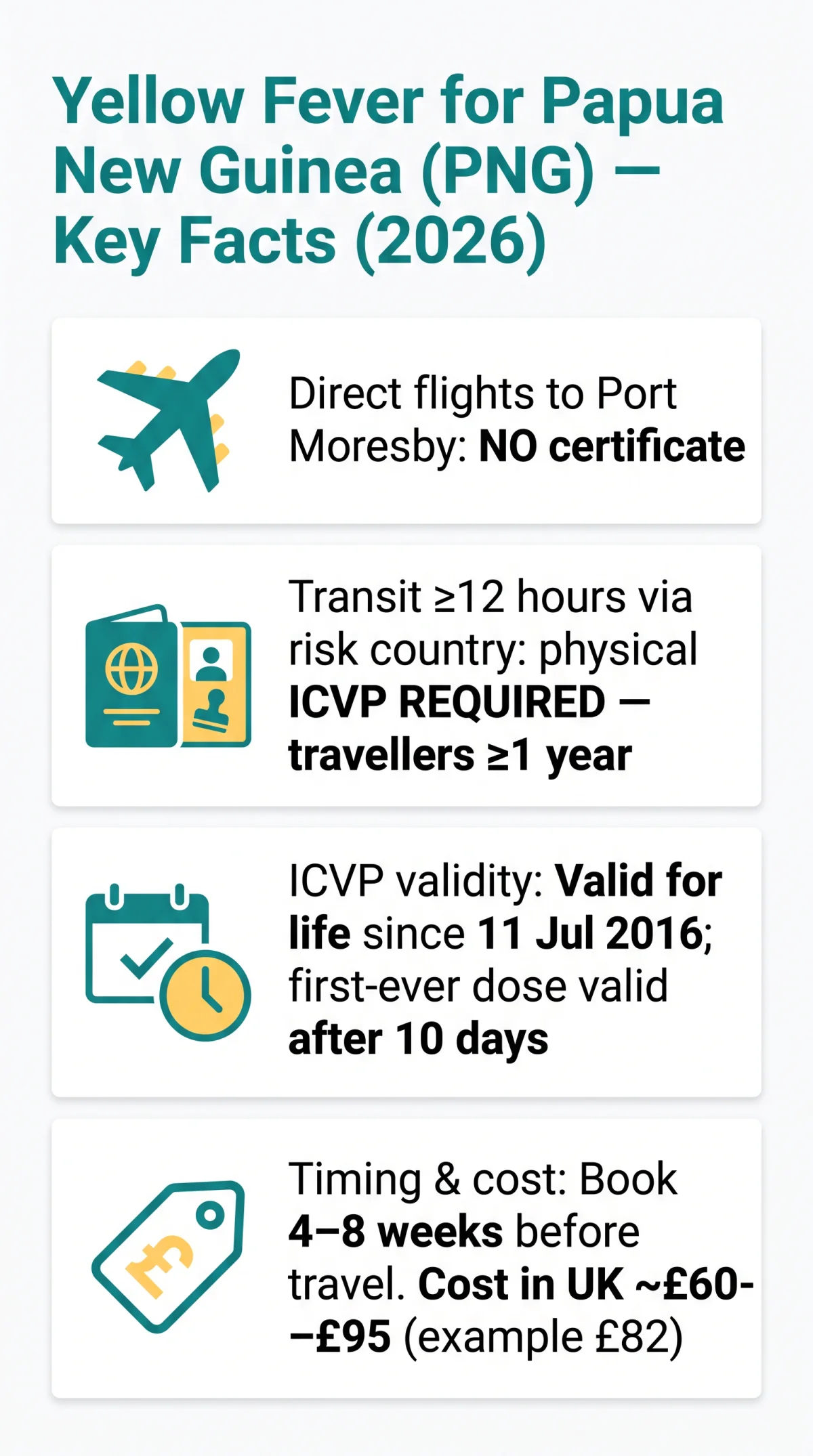
Do I need a yellow fever vaccine for PNG? Papua New Guinea is not a yellow fever endemic country, so the vaccine is not required for travellers arriving directly from the UK. However, if you transit through a yellow fever risk country for 12 hours or more, PNG immigration requires a valid International Certificate of Vaccination (ICVP) on entry in 2026.
The physical ICVP, issued by a registered UK Yellow Fever Vaccination Centre, is valid for life since the WHO IHR amendment of 11 July 2016. The WHO and FCDO travel advice confirm the requirement applies only to travellers aged ≥1 year transiting 12+ hours through any of the 40+ endemic countries.
Yellow Fever Certificate Requirements for Papua New Guinea
- Direct UK flights to Port Moresby: no certificate. Connecting via Addis Ababa, Johannesburg, Nairobi, or Entebbe: required for travellers aged ≥1 year.
- Present a physical ICVP (yellow card) at PNG border control. Digital copies are not accepted; enforcement has tightened at Jacksons International Airport in 2026.
- Valid for life since the WHO IHR amendment of 11 July 2016, regardless of old 10-year stamps. Boosters cannot be required as a condition of entry.
- Transit under 12 hours airside through a risk country’s airport may be exempt, but confirm with your airline.
Entry refusal or quarantine may result if the certificate is demanded and not presented at Papua New Guinea border control.
The 10-Day Validity Rule: Timing Your Vaccination
A first-ever yellow fever certificate is not legally valid until 10 calendar days after the dose. Previously vaccinated travellers face no waiting period. Schedule: Day 0 jab, Day 10 valid, Day 14 departure. Book your PNG travel clinic appointment at least 4 to 8 weeks before departure to Papua New Guinea.
What If You Can’t Get the Vaccine? Medical Exemptions
Papua New Guinea accepts the WHO Certificate of Medical Exemption (IHR Annex 7) for contraindications including severe egg allergy, immunosuppression, Thymus disorders, and infants <6 months. A licensed physician issues it for PNG immigration. Alternatively, route your travel to avoid yellow-fever-endemic countries entirely.
Recommended Vaccinations Before Travelling to Papua New Guinea
UK health authorities recommend Hepatitis A, Typhoid, and Tetanus-Diphtheria-Polio boosters for all Papua New Guinea travellers. Hepatitis B is recommended for long-stay visitors and healthcare workers in PNG. Ensure MMR is up to date, with an early dose for infants 6 to 11 months. COVID-19 vaccination should be current for all eligible travellers. Begin all courses 4 to 8 weeks before departure.
| Vaccine | UK Price | Doses | Timing |
|---|---|---|---|
| Hepatitis A | £67 | 1 | ≥2 weeks before |
| Hepatitis B | £156 | 3 (£52 each) | ≥3 weeks before |
| Typhoid | £42 | 1 | ≥2 weeks before |
| Tetanus/Diphtheria | £38 | 1 | Booster if >10 years |
| Polio | £32 | 1 | Booster if series completed |
| Cholera | £72 | 2 (£36 each) | Rural/poor sanitation areas |
| Japanese encephalitis | £234 | 2 (£117 each) | Rural long stays only |
Malaria Prevention for Papua New Guinea
Malaria is endemic throughout Papua New Guinea below 2,000 m, transmitted year-round, with chloroquine-resistant P. falciparum accounting for 75% of infections and P. vivax 25%. Chloroquine is not effective. Chemoprophylaxis is essential for PNG, classified as WHO Type C risk. Stand-by emergency treatment (SBET) is an option for low-risk rural itineraries. Dengue, Zika, and chikungunya are also present; use DEET ≥30% and permethrin-treated bed nets. Pregnant women should not travel due to Zika risk.
Comparing Malaria Prevention Drugs for PNG
Four chemoprophylaxis options exist for Papua New Guinea: atovaquone-proguanil (daily), doxycycline (daily), mefloquine (weekly), and tafenoquine (weekly). Tafenoquine requires mandatory G6PD deficiency blood testing before prescription due to life-threatening haemolysis risk in deficient individuals; plan testing 2 to 3 weeks ahead. The US CDC lists tafenoquine as the primary recommendation for PNG, subject to G6PD clearance.
Background Checks & Police Clearance for PNG Entry Approval
Tourist visas to Papua New Guinea (up to 60 days) require no background checks; police clearance certificates are mandated only for work and long-stay visas.
- Work and volunteer visas: Police Clearance Certificate (PCC) from countries lived in for ≥12 months in past 10 years.
- Long-stay visas (>90 days): PCC and TB chest X-ray at an approved UK clinic.
- HIV screening: May be requested at PNG Immigration & Citizenship Authority discretion.
- Document legalisation: UK police certificates may need an apostille or PNG embassy attestation.
Pre-Entry Medical Examination for Work & Long-Stay Visas
Applicants for long-stay Papua New Guinea visas must undergo a pre-entry medical examination, including a general physical assessment. Travellers bringing prescription medication into PNG must carry a GP letter on letterhead, keep medicines in original packaging, and obtain permits for controlled substances from the PNG Ministry of Health. Healthcare facilities in Papua New Guinea are very basic; medical evacuation by air ambulance to Australia may be necessary. Comprehensive travel health insurance covering evacuation and repatriation is essential. Altitude sickness risk exists in PNG highlands.
What to Expect at Port Moresby Airport & PNG Border Control
On arrival at Port Moresby (Jacksons International Airport), Papua New Guinea border control follows a standard sequence:
Health Declaration
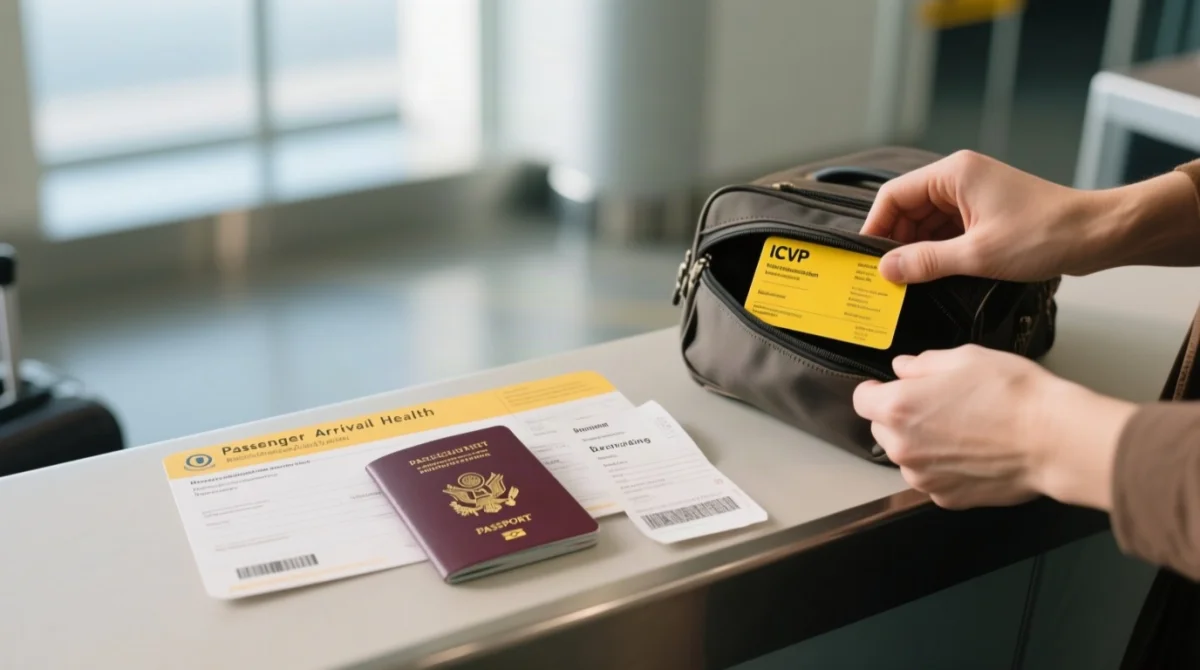
Complete a Passenger Arrival Health Declaration card on the plane or at kiosks in the arrivals hall
Passport & Visa
Present passport and visa at the PNG immigration counter for verification
Yellow Fever Check
ICVP inspection if arriving from or transiting through a WHO-listed risk country – carry the physical card in hand luggage
Customs Declaration
Declare medications, food, and restricted items
Getting Your Yellow Fever Certificate in the UK: Clinics & Costs (2026)
Book a Clinic
Find a registered Yellow Fever Vaccination Centre via TravelHealthPro – NHS does not fund this vaccine; private only
Attend Appointment
At least 4-6 weeks before departure. Stamaril is the only UK-licensed brand; ICVP name must match your passport exactly
Budget the Cost
£82 per dose at Superdrug (0333 311 1007); UK prices range from £60 to £95
Carry the Original
Keep the physical ICVP in hand luggage when flying into Port Moresby – digital copies are not accepted
Frequently Asked Questions: Yellow Fever, Health Requirements & Background Checks for PNG
Do UK citizens need a yellow fever certificate for Papua New Guinea?
No. Direct London to Port Moresby flights need no certificate. Transit of 12+ hours through a WHO-listed endemic country (Ethiopia, Kenya, South Africa) makes a valid ICVP compulsory at PNG border control.
Is a yellow fever vaccine required if I’m only transiting through a risk country to PNG?
Transit under 12 hours airside may be exempt, but rules vary by airline. Overland transit always requires the certificate for Papua New Guinea entry.
How long is a yellow fever certificate valid?
Valid for life since the WHO IHR amendment of 11 July 2016. As of September 2026, PNG has not changed this policy. Immigration cannot reject an old certificate because >10 years have passed, nor require boosters.
What happens if I arrive in PNG without a yellow fever certificate?
Refusal of entry, on-site vaccination, or quarantine may result. Carry the physical ICVP in hand luggage.
Are background checks needed for tourist entry to PNG?
No. Tourist visas (up to 60 days) require no police clearance certificate. Background checks apply only to work, volunteer, and long-stay visa categories.
Which countries are on the yellow fever risk list for PNG entry?
The WHO maintains a list of 40+ countries across sub-Saharan Africa, South America, and parts of Central America and the Caribbean where yellow fever is endemic.
Can I bring prescription medication into Papua New Guinea?
Yes, with a GP letter on letterhead, original packaging, and quantity limits. Controlled substances may require a PNG Ministry of Health permit.
Do children need a yellow fever certificate for Papua New Guinea?
Children aged ≥1 year require the certificate if arriving from a risk country. Vaccination is available from 9 months. Infants under 6 months may receive a WHO Certificate of Medical Exemption.
What vaccinations does the UK Foreign Office recommend for Papua New Guinea?
The FCDO directs travellers to TravelHealthPro. Key recommendations include Hepatitis A, Typhoid, Tdap booster, and malaria chemoprophylaxis for PNG.
Is malaria a serious risk for travellers in Papua New Guinea?
Yes. Malaria is endemic below 2,000 m year-round; chloroquine-resistant P. falciparum causes ~75% of infections. Chemoprophylaxis is essential.
Last reviewed: 14 September 2026. This article provides general guidance only and does not constitute medical advice. Always consult a registered Yellow Fever Vaccination Centre and check FCDO travel advice for Papua New Guinea before departure.